Jobs


Young workers may feel AI disruption first. IMF and World Bank officials are focusing on entry-level roles and weakening demand for recent graduates.
Small-business AI users are more optimistic about employment. New York Fed research found AI adopters were more likely than non-users to expect employment growth over the next year. Liberty Street Economics
Neither finding proves how many jobs AI will create or eliminate. The IMF figures measure exposure and risk, while the New York Fed survey measures employer expectations rather than actual future hiring.
AI adoption is drawing two very different readings from officials and researchers this month. The International Monetary Fund’s leader warned of a “slow-moving tsunami” for workers, while a New York Fed survey found small businesses already using AI were more likely to expect to add employees. The two findings measure different things, and neither is a count of jobs gained or lost.
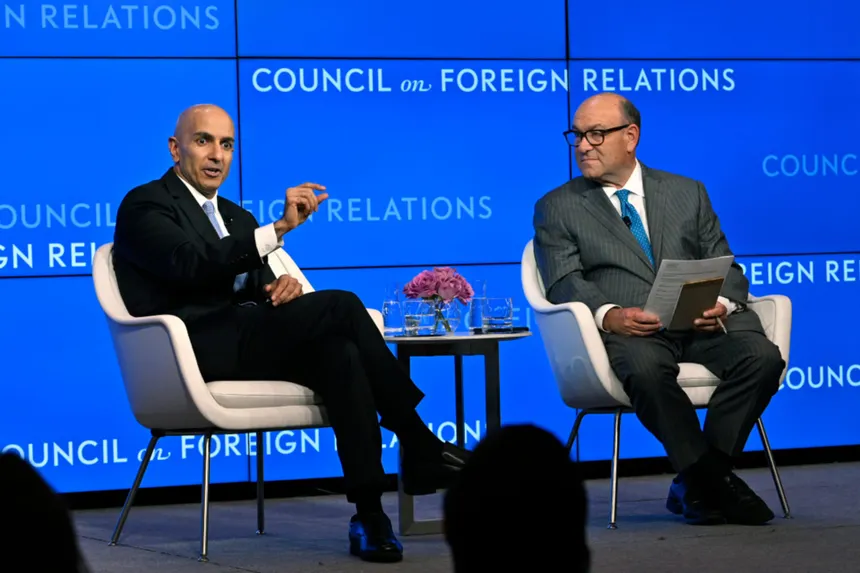
“The first rung in employment, your first job upon graduation, is now seeing less demand.”
Singapore President Tharman Shanmugaratnam
The warning: young graduates first
CNBC reported that IMF Managing Director Kristalina Georgieva told a panel on Monday that AI is hitting the global labor market like a “slow-moving tsunami,” with young people entering the workforce first in line. Entry-level roles that were once routine, she said, are the ones at risk, and those jobs have traditionally been how workers moved up the ranks.
The IMF estimates that about 40% of jobs worldwide will eventually be “augmented, downgraded or eliminated,” according to CNBC’s account of her remarks. Exposure is about 60% in advanced economies and 23% in low-income countries. Georgieva said poorer nations are not better off: their lower exposure is “just because AI is further away.” That figure describes exposure to change over time. It is not a forecast of how many jobs will disappear, and “augmented” covers jobs that may get easier or better.
Singapore President Tharman Shanmugaratnam, who co-chairs the World Bank’s Jobs Council, said that in the U.S. demand for graduates has gone down “for the first time in a century,” and that the wage premium for a college degree is shrinking. He urged governments to treat “crisis-era” support measures as a permanent tool and to give firms incentives to hire new graduates. Those are his statements as reported by CNBC. The report does not lay out the underlying data.
The counterpoint: growth, and slower displacement
The picture in the same CNBC report was not uniformly grim. World Bank President Ajay Banga said large language models will probably cause some disruption in developed-world jobs. In middle-income and lower-middle-income countries, he said, the opportunity from “small AI” to build jobs and productivity is “enormous.”
Georgieva also estimated that AI adoption could lift growth by 0.5 to 1 percentage point in advanced Asia and by 0.2 to 0.8 percentage point in emerging Asia. These are projections for Asia, not U.S. estimates. Shanmugaratnam added that displacement will come “task by task,” which “gives us time,” provided workers can learn on the job and universities move toward applied training. He also cautioned that growth alone may not create jobs.
The survey: optimism among small-business AI users
The New York Fed’s Liberty Street Economics blog, in an October 8 post by Will Aarons and Asani Sarkar, begins by noting there is little consensus on AI’s employment effects. Economy-wide pay and headcount have moved little as AI use has spread, the authors write, while narrower measures show declining hiring for workers early in their careers or in AI-exposed occupations.
The authors used the 2025 Small Business Credit Survey, fielded from September to November 2025. Of firms with at least one employee, 46% said their business or employees were using AI tools, and another 15% planned to start within twelve months. Among users, 63% said AI was somewhat or very important to production, and 51% had integrated it partially or fully into business processes. Some 77% of respondents reported no change in labor costs from using AI.
Looking ahead twelve months, AI users had a net expectation of higher employment of 33 percentage points, versus 15 points for non-users. That is the share expecting an increase minus the share expecting a decrease. After controlling for firm and owner characteristics and location, the gap was 13 points. With prior-year employment changes added, it was 10 points. The authors also report that revenue expectations were most optimistic for AI users facing operational challenges with technology.
Small-Business Employment Expectations
33 vs. 15 points
Among employer firms in the 2025 Small Business Credit Survey, AI users had a 33-percentage-point net expectation of higher employment over the next twelve months, compared with 15 points for non-users.
How strong is the evidence?
The survey’s responses are weighted to match the national population of U.S. employer firms, with 5,248 firms in the AI module and 4,769 in the controlled sample. But it captures expectations, not realized hiring. It is also a snapshot from late 2025 that reflects owners’ self-reports, so it shows an association between AI use and optimism, not proof that AI creates jobs. The gap shrinks, though it does not vanish, as more controls are added.
The IMF and World Bank comments are remarks by officials, relayed by a news outlet, and they mix estimates, projections and warnings. They are best read as signals of where policymakers’ concerns lie. The New York Fed authors point to a narrower pattern: hiring for early-career and AI-exposed workers appears softer, while broad pay and headcount measures have barely moved. For households, especially new graduates and their families, that makes entry-level hiring the area to watch, with the original sources the place to check for methodology and the latest numbers.
For education and information only. This report does not provide personalized financial, investment, tax, or legal advice.