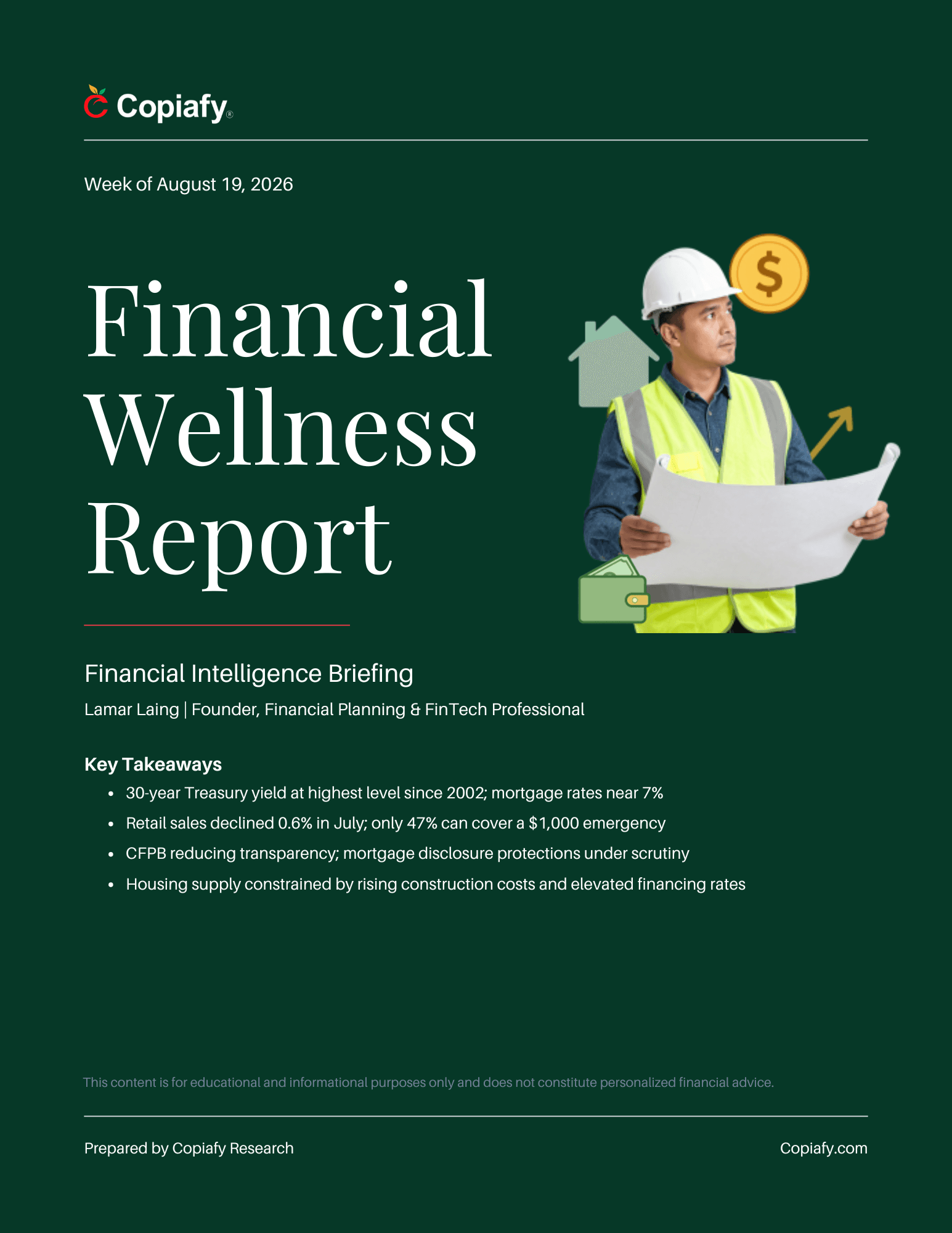
Financial Wellness
The clearest story emerging from the past several days is a growing disconnect between financial markets and household finances.
Long-term borrowing costs continue to rise. The 30-year Treasury yield reached approximately 5.322% on August 18, its highest level since 2002, while the 30-year fixed mortgage rate remained around 6.86%. That follows several days of already-elevated bond yields, persistent inflation concerns, and a labor market showing signs of weakness.
At the household level, the pressure is becoming increasingly visible. Retail sales declined 0.6% in July, real household buying power slipped 0.1% over the prior year, and only 47% of Americans reportedly have enough savings or access to funds to cover a $1,000 emergency. Buy Now, Pay Later products are now being marketed for essentials such as rent and electricity, with half of users surveyed saying they could not make ends meet without them.
The jobs picture is similarly uneven. Washington, D.C. now has the country's highest overall unemployment rate, while Black unemployment in the District has reached 10.1%. Earlier labor data also showed significant downward revisions to employment growth, adding to concerns that headline unemployment statistics may be masking stress within particular industries and communities.
Housing remains one of the most persistent pressure points. Mortgage rates are still near 7%, construction input prices have risen sharply, affordable housing restrictions are expiring in several cities, and high financing costs continue to constrain supply. At the same time, cash buyers are becoming slightly less dominant, home-price growth is slowing, and inventory is improving — giving financed buyers modestly more room to compete.
Consumer protection policy is also shifting. The CFPB has stopped publishing consumer complaint narratives and visualizations, federal regulators continue revisiting lending and disclosure rules, and new questions are emerging around AI-driven financial decisions, alternative home equity products, and increasingly essential uses of short-term credit.
The broad financial markets, meanwhile, remain surprisingly resilient. Small-cap, international, emerging-market, and technology equities have all participated in a broad 2026 rally. That strength contrasts sharply with deteriorating household sentiment and rising borrowing costs — one of the defining contradictions of the current economy.
🏛️ Government & Consumer Policy
CFPB Ends Public Consumer Complaint Narratives
The Consumer Financial Protection Bureau announced that it will no longer publish consumer complaint narratives and related data visualizations from its complaint database.
The CFPB argues that the narratives are unverified, one-sided accounts that can create misleading impressions about financial institutions. Consumer advocacy organizations, including the National Consumer Law Center, argue that removing them limits transparency and makes it harder for journalists, lawmakers, law enforcement agencies, and consumers to identify patterns of potential financial harm.
The database itself remains, but the public's ability to review the underlying consumer stories has been reduced.
Why it matters: The change removes a free research tool consumers could use when evaluating lenders, banks, debt collectors, and other financial companies.
Copiafy coverage: https://www.copiafy.com/news/cfpb-stops-publishing-consumer-complaint-narratives
Mortgage Disclosure Protections Face New Scrutiny
Consumer advocates are also raising concerns over potential changes to Truth in Lending and RESPA mortgage disclosure requirements.
The National Consumer Law Center argues that weakening or simplifying some disclosure requirements could make it harder for borrowers — particularly first-time homebuyers — to identify unexpected costs or unfavorable loan terms before closing.
Why it matters: Mortgage transactions are among the largest financial commitments most households make. Clear disclosures are especially important when borrowing costs and affordability are already stretched.
Copiafy coverage: https://www.copiafy.com/news/cfpb-weighs-loosening-mortgage-disclosure-rules
D.C. Black Unemployment Reaches 10.1%
Washington, D.C. now has the nation's highest overall unemployment rate, while Black unemployment in the District has reached 10.1%.
Federal workforce reductions are cited as a major contributor, but the effects extend beyond federal employees. Reduced employment and income can ripple through local restaurants, housing, retail businesses, professional services, and other parts of the regional economy.
Why it matters: National employment statistics can conceal substantial differences across communities. Concentrated unemployment increases the risk of missed housing payments, rising debt, and deteriorating credit in the households most affected.
Copiafy coverage: https://www.copiafy.com/news/dc-black-unemployment-hits-10-percent
Michigan Tightens Unemployment Benefit Requirements
Michigan has increased the number of required weekly job-search activities for unemployment recipients from one to three.
The new rules took effect July 19. Workers who do not document the required activities risk losing benefits.
Why it matters: Administrative requirements can have immediate financial consequences for unemployed households, particularly workers facing limited internet access, language barriers, transportation challenges, or fewer available jobs.
Copiafy coverage: https://www.copiafy.com/news/michigan-unemployment-work-search-requirement-2026
California Gig Workers Move Closer to Unionizing
California Uber and Lyft drivers have moved closer to gaining collective bargaining rights, potentially creating a significant shift in how gig workers negotiate wages and benefits.
The development comes as gig work and side hustles play a growing role in household income.
Why it matters: Changes to gig-worker compensation and benefits could affect both workers' financial security and the cost of app-based transportation and delivery services.
Copiafy coverage: https://www.copiafy.com/news/california-uber-lyft-drivers-near-union-certification
📈 Markets & Economy
30-Year Treasury Yield Reaches Highest Level Since 2002
The 30-year Treasury yield climbed to approximately 5.322% on August 18, its highest point since 2002.
This follows several days of elevated long-term yields and continued concerns about inflation, federal borrowing, and the government's long-term fiscal outlook.
The effects extend well beyond bond investors. Long-term Treasury yields influence mortgage rates and broader borrowing conditions throughout the economy.
Why it matters: Higher long-term yields make borrowing more expensive for households and businesses and can keep mortgage rates elevated even if the Federal Reserve eventually lowers shorter-term policy rates.
Copiafy coverage: https://www.copiafy.com/news/30-year-treasury-yield-19-year-high
Mortgage Rates Remain Near 7%
The 30-year fixed mortgage rate remains around 6.86%, keeping housing payments elevated for prospective buyers.
The challenge is compounded by home prices that remain high relative to household incomes. Earlier analysis found U.S. home-price-to-income ratios at historically stretched levels.
There are, however, early signs of adjustment. Cash buyers represented 31.4% of home sales during the first four months of 2026, down from 32.3% a year earlier, while median home-price growth slowed to only 0.2% year over year.
Why it matters: Buyers are gaining slightly more negotiating room, but financing remains expensive enough to keep affordability difficult for millions of households.
Copiafy coverage: https://www.copiafy.com/news/mortgage-rates-cash-buyers-home-affordability-2026
Construction Costs Are Adding Another Housing Pressure
Construction input prices increased 7.4% year over year as of July.
Iron and steel prices were up 17.6%, while copper wire increased 17.9%.
Those increases make new housing more expensive to build at the same time that many markets already face constrained supply and high mortgage rates.
Why it matters: Housing affordability can't be solved by interest rates alone. If new homes become increasingly expensive to build, supply may remain constrained even if borrowing costs eventually decline.
Copiafy coverage: https://www.copiafy.com/news/construction-costs-contractor-backlogs-housing-supply
Housing Loan Defects Are Rising
The mortgage critical defect rate increased to 1.71% in Q1 2026, up from 1.38% in the previous quarter.
Legal, regulatory, and compliance issues represented 26.02% of identified defects, their highest share since Q1 2021.
Why it matters: Loan defects can cause delays, repurchase demands, underwriting problems, or complications late in the mortgage process.
Copiafy coverage: https://www.copiafy.com/news/mortgage-critical-defect-rate-rises-q1-2026
The Consumer Is Pulling Back
Retail sales declined 0.6% in July, a larger drop than expected and a reversal from June.
At the same time, consumer sentiment declined sharply in early August, while gasoline prices approached record August levels.
Earlier data also showed that average household buying power fell 0.1% over the past year, despite moderating inflation.
Why it matters: Consumers spending less while prices remain elevated can signal that household budgets are becoming constrained rather than simply becoming more cautious.
Copiafy coverage: https://www.copiafy.com/news/consumer-pullback-retail-sales-sentiment-2026
Wholesale Inflation Offers Some Relief—But Energy Remains a Risk
Producer prices were flat in July, compared with expectations for a 0.2% increase.
That is a positive inflation signal, but energy markets remain volatile as the Iran conflict continues affecting global oil prices.
At the same time, concerns have emerged over the condition of the U.S. Strategic Petroleum Reserve after significant drawdowns, with reports warning that depletion could affect the physical integrity of some storage caverns.
Why it matters: Falling wholesale inflation could eventually ease consumer price pressure, but another significant energy shock could reverse some of that progress.
Copiafy coverage: https://www.copiafy.com/news/wholesale-inflation-cools-spr-oil-reserve-risk
Markets Remain Strong Despite Household Stress
Equity markets are telling a very different story from household budgets.
The Russell 2000 has risen nearly 25% in 2026, while emerging markets are up more than 20%. Mid-cap and international markets have also participated in the rally.
Technology valuations have actually declined relative to earnings despite substantial price gains, because corporate earnings have been growing faster than stock prices.
At the same time, elevated Treasury yields and geopolitical tensions remain potential risks.
Why it matters: A strong stock market does not necessarily mean households are experiencing a strong economy. Market gains disproportionately benefit households with significant invested assets.
Copiafy coverage: https://www.copiafy.com/news/stock-market-strength-household-stress-2026
💼 Jobs & Household Finances
Emergency Savings Remain Thin
A 2026 Bankrate survey cited by GreenPath found that only 47% of Americans have enough savings or other immediately accessible funds to cover a $1,000 emergency.
Another 29% have more credit card debt than emergency savings.
Those numbers are particularly significant while borrowing costs remain elevated.
Why it matters: A relatively ordinary expense — a vehicle repair, medical bill, or home emergency — can force households without savings to rely on high-interest debt.
Copiafy coverage: https://www.copiafy.com/news/emergency-savings-remain-thin-2026
Buy Now, Pay Later Is Moving Into Rent and Utilities
Buy Now, Pay Later products are increasingly being marketed for essential expenses, including rent and electricity bills.
According to reporting highlighted by the National Consumer Law Center, half of BNPL users surveyed said they could not make ends meet without these products.
That represents a significant shift from BNPL's original role financing discretionary purchases.
Why it matters: Financing recurring essentials can create a cycle in which today's shortfall becomes another payment obligation next month.
Copiafy coverage: https://www.copiafy.com/news/bnpl-loans-rent-utilities-essentials-2026
Credit Card Stress Is Increasing
Credit card delinquency remains elevated, while the Federal Reserve Bank of New York is examining diverging measures of consumer credit stress.
Combined with thin emergency savings and persistent borrowing costs, the data suggest a growing number of households have less room to absorb financial shocks.
Why it matters: Credit card debt can become particularly difficult to escape when interest rates remain high and household income isn't keeping pace with expenses.
Copiafy coverage: https://www.copiafy.com/news/credit-card-delinquency-highest-since-great-recession
Affordable Housing Is Expiring Block by Block
Housing affordability isn't only about buying a home.
In Boston's Jamaica Plain neighborhood, residents are fighting to preserve 147 affordable units for elderly and disabled residents after long-standing affordability restrictions expired.
In Philadelphia, city officials are working to preserve nearly 1,000 affordable rentals as federal tax-credit affordability periods reach expiration.
Why it matters: When affordability requirements expire, existing tenants can face significant rent increases or displacement even if no new development occurs.
Copiafy coverage: https://www.copiafy.com/news/affordable-housing-expiring-tenant-organizing-2026
College's Return on Investment Is Being Reconsidered
Confidence in higher education has fallen across political affiliations and education levels, according to Axios.
At the same time, students are reassessing majors and career paths as AI changes the skills employers expect from entry-level workers.
Families are increasingly asking not simply whether a school offers a degree, but whether it can demonstrate employer relationships, internships, and realistic career pathways.
Why it matters: Education debt is fixed once borrowed. The income generated by a degree is not. That makes career outcomes increasingly important when evaluating the financial value of higher education.
Copiafy coverage: https://www.copiafy.com/news/college-return-on-investment-reconsidered-2026
Support & Resources
Legal & Compliance
Sign up for Copiafy newsletter.
Get free articles and downloads.
Disclaimer: The content on this site is for informational purposes only and does not constitute legal or financial advice. Copiafy is not a law firm, credit counseling agency, or licensed financial advisor. Information provided is general in nature and may not apply to your individual circumstances. For advice specific to your situation, consult a qualified attorney or financial professional. Results from credit disputes vary and cannot be guaranteed.